
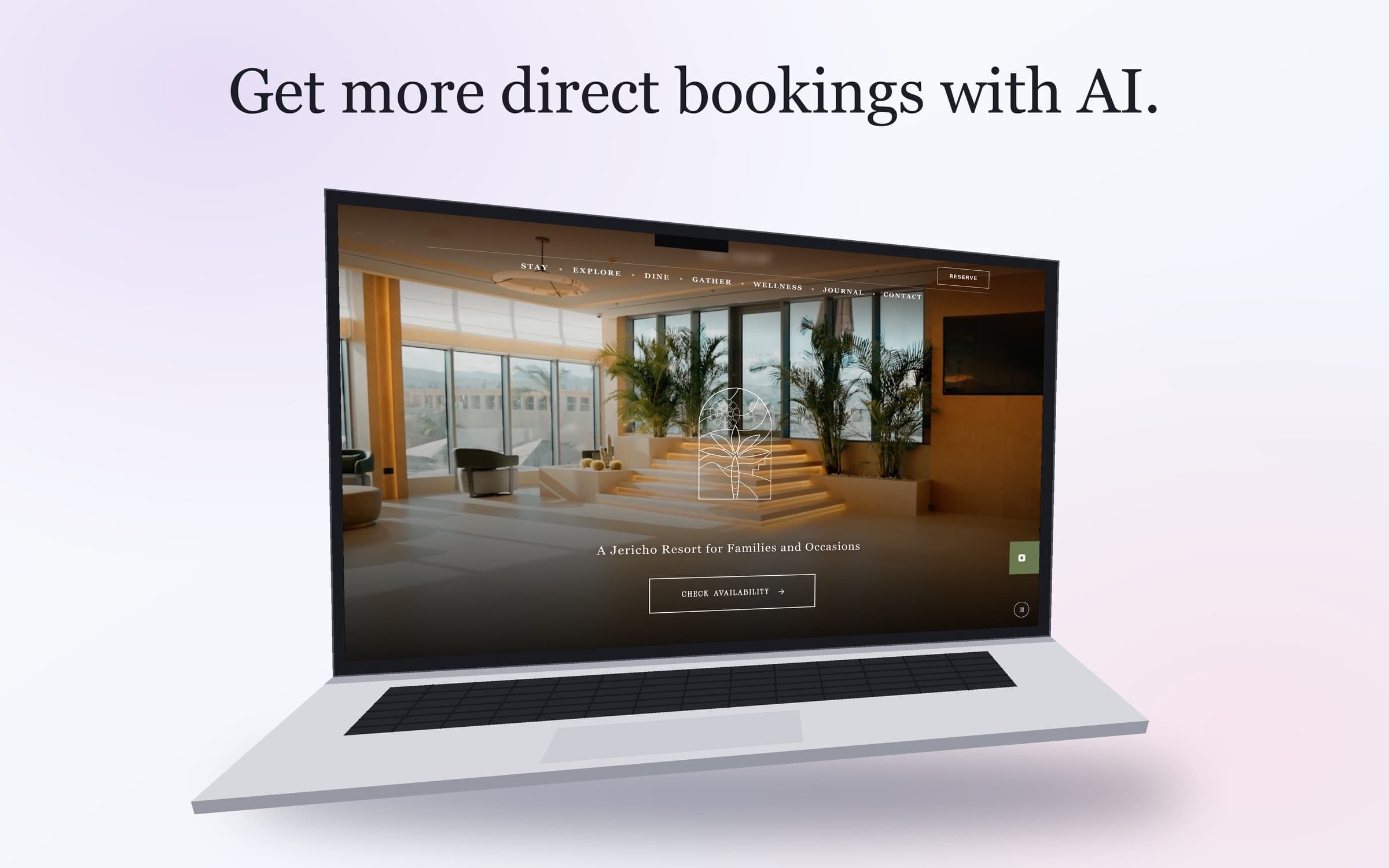
Your resort might have 30k followers on Instagram, and ChatGPT still won't recommend it.
Maybe you have fewer, but it doesn't matter. ChatGPT doesn't read your followers or your posts.
When a friend of mine was building his resort, he asked me what his next big move should be. My answer was simple: a website.
In this guide I'll show you how that website took him from nobody knowing the place existed to 234 unique visitors a day in high season.
Why this matters now
While the resort was still being built, nobody knew about it, and neither did ChatGPT. AI models can only work with what's written online, and they lean on the same websites Google already indexes. So however many Instagram posts you have, a website with good SEO will always outrank them.
That matters more every year, because more and more travellers now ask ChatGPT to plan their trip for them. If you aren't visible to AI, someone else is.
A website kills two birds with one stone. It saves you the 18% or so that Booking takes on every guest who books with you directly, and it puts you in front of people who are already looking for a place like yours.
Here are the six steps I took to get his resort from zero to thousands of visitors a month.
Is it even for you?
First, check whether you need this at all. Open ChatGPT and ask: "I'm going on a trip to [city], which hotel is good for a family with two kids?"
If your hotel doesn't come up, this guide is for you.
If it does come up, ask ChatGPT where it got its facts. If the answer is Booking or Expedia, they own the guest who finds you that way, and they take around 18% of every booking it brings.
Try it, then tell me what it said. Tag me on LinkedIn.
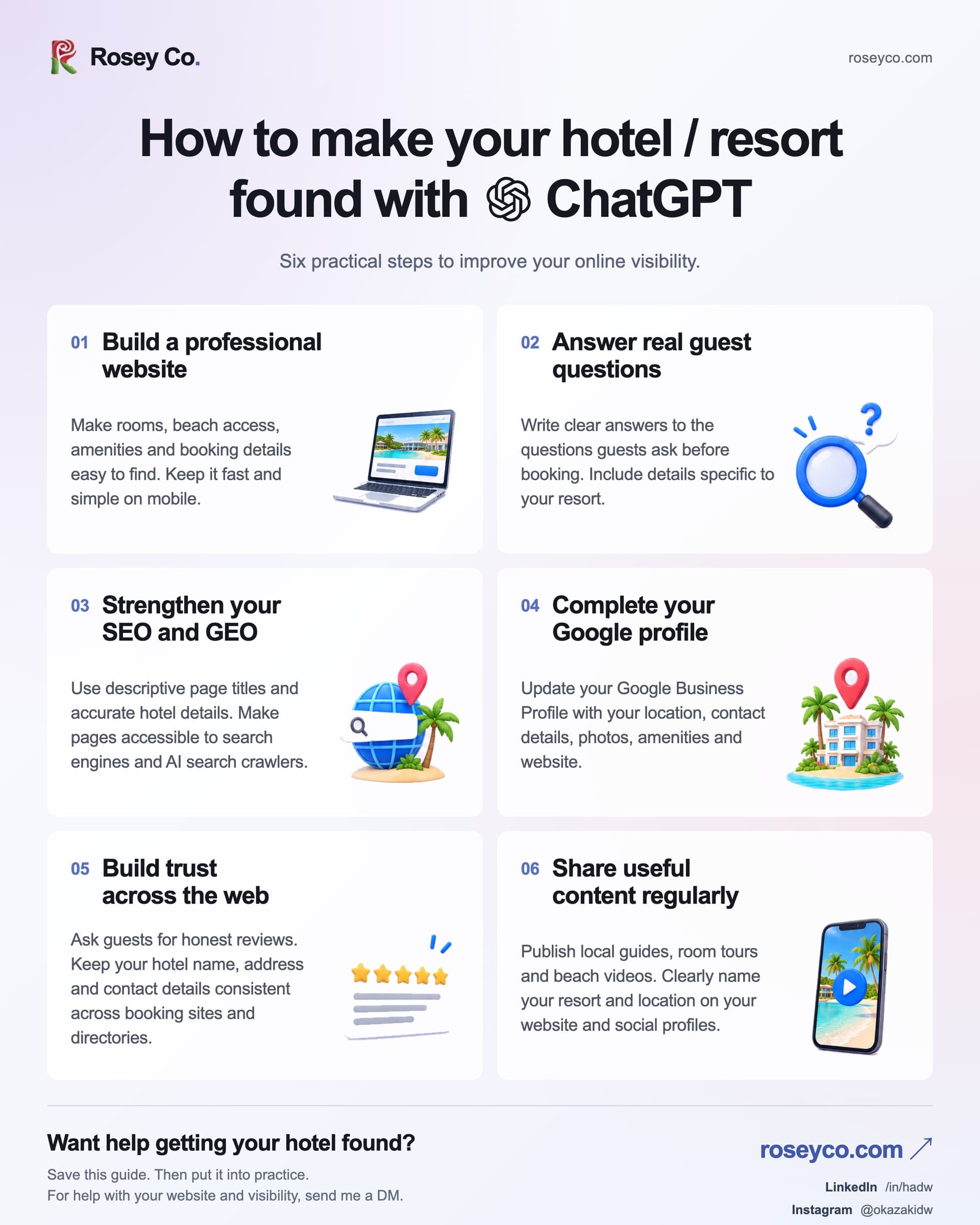
Here's the whole guide on one page, so you can save it and come back to it.
1. Build a professional website
This is the step everything else sits on, so I'll spend the most time here.
When I asked ChatGPT about my friend's resort after the site went live, it listed the 25-metre pool and its opening hours, the children's area with a lifeguard, the family suites, and that breakfast is included. Then it said where it got all that from: "based on the resort's official website."
It didn't quote a single Instagram post. 30k followers, and the model read the website the way a guest reads Google.
So the website has to say the things a guest asks. Not "a sanctuary of calm". The facts.
Here is what I put on his site, and what I'd put on yours:
- A page per room type, with the price range, the bed setup, how many people fit, and real photos of that room.
- A page for the pool and facilities with opening hours, the kids' area, what's included and what costs extra.
- A page for events and weddings with capacities, a sample menu, a price-from figure and a real enquiry form that someone answers.
- A location page that says how to get there from the airport, by car, by taxi, and how long it takes.
- A contact page with a phone number that a human picks up.
- The Book button visible on every page without scrolling, on a phone.
That last one matters more than it sounds. In the hotel owner forums I read for this, a guest put it plainly: on a lot of small hotel sites "the book now button is hidden in some obscure menu, or bottom of a long page. Sometimes you click it and you get an error page." He added: "I doubt they even know it's happening."
Check yours on your phone tonight. If it takes more than two taps to see a price, that's where your direct bookings are leaking.
2. Answer real guest questions on your own pages
The questions already exist. They come in every day at the front desk, in your Booking inbox, on the phone and in reviews.
"Is the pool heated?" "Do you have a cot?" "Can we check in at 11?" "Is there parking?" "Can kids use the spa?"
Write the answer on the page the question belongs to. The pool question goes on the pool page. The cot question goes on the room page. Not in a 40-question FAQ dump nobody scrolls.
Why it matters for AI: a marketer I follow asked three different AI systems about the same ski resort for a family trip. Each gave a slightly different picture. One suggested a chalet category the others didn't. The breakfast answers didn't match. Only one mentioned an age restriction for the spa.
That last one is the expensive miss. A family books on one model's answer, turns up, and the kids can't use the spa. The model didn't invent that gap. The hotel never wrote the answer down anywhere a model could read it.
One habit fixes this: every time a guest asks a question twice, it goes on the page.
3. Strengthen your SEO and GEO
SEO you've heard of. GEO stands for generative engine optimisation, and it's less complicated than the name. It means writing the facts the models quote, in words a model can lift, on a page a model can read.
In practice, for a hotel, both come down to the same list:
- Page titles that say what the page is. "Family Suites with Pool View, [Town]" beats "Accommodation".
- One page per thing. Rooms, pool, weddings, restaurant, location. Not one long homepage.
- Facts as text, not pictures. A menu as a PDF or a price list as an image is invisible to Google and to ChatGPT. Type it out.
- Your name, town and what you are in the first paragraph of the homepage. "A family resort with a pool in [Town], 5 minutes from [landmark]."
- Let the crawlers in. If your site builder has a "discourage search engines" box ticked, or a robots file that blocks everything, nothing above matters. Ask whoever built the site.
- Speed on a phone. Most of your guests will open the site on a phone from a Booking search. If it takes 5 seconds to load, they go back.
None of this needs an agency. It needs someone to spend an afternoon with the site open and the guest questions from step 2 in front of them.
4. Complete your Google Business Profile
This is the first place both Google and the AI models look for the basics: are you open, where are you, what's your number, what do you look like.
If it's half filled in, that's what they see.
Fill in the lot: the right category (hotel or resort, not "business"), the exact address, the phone number, the opening hours of the pool and restaurant, the amenities list, and the link to your website. Then upload photos of the actual rooms and the actual pool, not the brochure renders.
And reply to reviews. All of them, including the bad ones, in a normal human tone. Google reads the replies. So do the next 50 guests.
5. Build trust across the web
When ChatGPT answered about my friend's resort, it got the facts right and then said one thing it couldn't do: it couldn't find enough independent guest reviews to call it one of the best family resorts in the area.
That tells you how these models think. Your website for the facts. Other people for the trust.
Two jobs here.
First, ask for reviews. The best time is checkout, in person, with one sentence: "If you enjoyed your stay, a Google review really helps us, here's the link." A card with a QR code on the desk does the rest.
Second, be the same hotel everywhere. Same name, same address, same phone number on Google, Booking, Expedia, Tripadvisor, Facebook and your own site. If one listing says "Resort & Spa" and another says "Hotel", with a different phone number, the models can't be sure it's one place, and they say less about you.
6. Share useful content regularly
Once the site is right, give Google and the models something new to find every month.
This doesn't mean a blog nobody reads. It means:
- A local guide. What to do in [Town] with kids, where to eat near the hotel, how to get to the main sight.
- A room tour. One short video, phone and good light, the actual room.
- An event recap. The wedding you hosted in May, with photos and the capacity.
- A seasonal page. Pool opening dates, summer hours, Ramadan hours, whatever applies to you.
Say the name of your hotel and the town in every one. Out loud in the video, in the title of the page. The models need the name next to the facts to connect them.
What to expect
Here are the real numbers from my friend's resort, so you know what this looks like.
In peak season this summer, Google alone sent the site 234 visitors a day. The site only went live in May.
Off season it drops. It's a pool resort, so it should.
AI traffic is small today, single digits a day. I'm not going to tell you ChatGPT will fill your rooms next month. What the website did is make the AI answers correct, and make Google send people, and both of those are the job right now. The AI share grows on its own as more travellers plan trips that way.
What it didn't do is replace Booking overnight. OTAs took 63.4% of independent hotel bookings in 2025, up from 61.3% the year before, according to Cloudbeds' 2026 State of Independent Hotels report. You're not leaving them. You're giving guests who found you there a reason to book with you instead.
Frequently asked questions
How much does Booking.com charge a hotel?
The base commission is usually 15% to 18% of the booking, including the taxes the guest pays. Add the Genius discount, the Preferred Partner uplift and payment processing and most owners land between 17% and 22% all in. A guest who books direct costs you the card fee and nothing else.
Can I offer a lower price on my own website than on Booking.com?
In the EU, yes. The Digital Markets Act banned Booking.com's price parity clauses from July 2024, so the contract no longer stops you. Outside the EU it depends on your contract and your market. Either way, you can always make the direct offer better without touching the price: free cancellation, breakfast included, a late checkout, or room types you only sell on your own site.
Does ChatGPT recommend hotels?
Yes, and it reads your website to do it. When I asked it about a resort with no website, it had nothing. When I asked after the site went live, it listed the pool, the kids' area and the breakfast, and said it got the facts "based on the resort's official website." Where there is no site, it reads Booking and Expedia instead.
Is a website worth it for a 20-room hotel?
Do the maths on your own numbers. If you take 1,000 bookings a year at an average of 150 and 60% come through OTAs, you're paying around 16,000 a year in commission at 18%. Moving one in five of those to direct pays for the website in year one. The website also answers the phone at 2am, which the front desk doesn't.
What is the difference between SEO and GEO?
SEO is making your pages easy for Google to find and rank. GEO is making the facts on those pages easy for AI models like ChatGPT to read and quote. For a hotel, the work is nearly the same: clear titles, one page per thing, facts as text, and your name next to those facts.
If you'd rather have this done
This is what I do for hotels and resorts: the website, the pages above, the Google profile, and the monthly content, measured in direct bookings.
If you'd rather talk it through than do it yourself, book a 15-minute call and bring your ChatGPT answer.
Want Results Like These?
Book a free strategy call and discover how we can help grow your business.
Get Your Free Strategy Call